
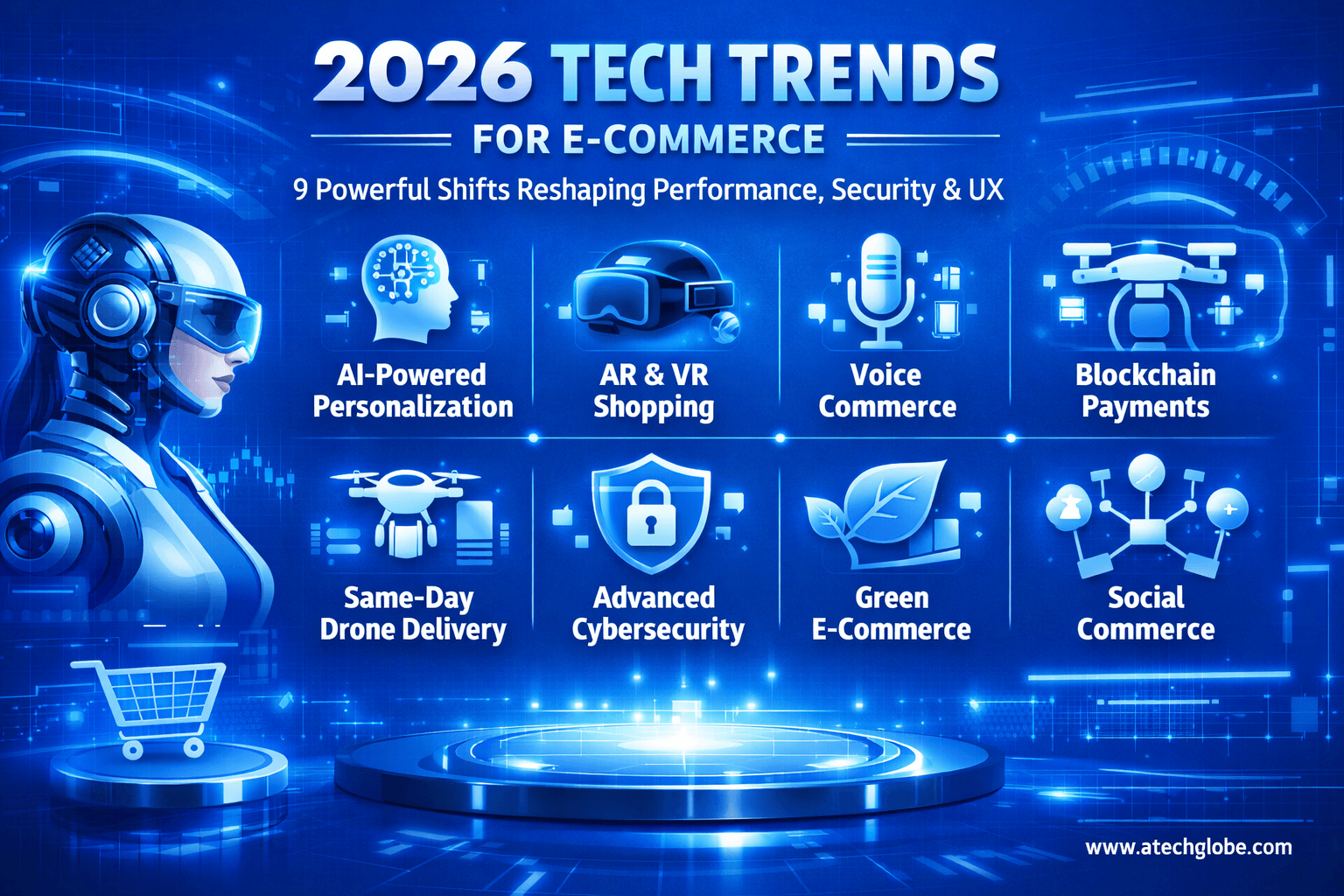
The conversation around 2026 tech trends for e-commerce is no longer speculative. It’s operational. Platforms are evolving, security standards are tightening, and user expectations are climbing fast.
If you run an online store—or build solutions for one—these changes directly affect your growth. Performance impacts rankings. Security affects trust. UX determines conversion.
In short, 2026 tech trends for e-commerce aren’t about shiny tools. They’re about sustainable, scalable infrastructure.
Companies like Atech Globe (atechglobe.com) already focus on helping brands align technology with measurable business outcomes. And that alignment is exactly what 2026 demands.
Let’s break it down.
Table of Contents
- Why 2026 Tech Trends for E-commerce Matter
- Performance: Speed Is Now a Revenue Strategy
- Security: Zero Trust Becomes Standard
- UX: Human-Centered, Frictionless Design
- AI & Intelligent Personalization
- Headless & Composable Architecture
- Mobile-First & Edge Computing
- Compliance & Data Protection
- Practical Action Plan for 2026
- Conclusion
Why 2026 Tech Trends for E-commerce Matter
Global e-commerce continues to expand. According to the United Nations Conference on Trade and Development (UNCTAD), global online retail sales have represented a significant and growing share of total retail in recent years.
Growth alone isn’t the story.
The real shift lies in expectations:
- Customers demand instant load times.
- Regulators require strict data protection.
- Search engines prioritize real user experience signals.
- Platforms that ignore performance, security, or UX don’t just fall behind—they disappear from search visibility and customer trust.
- Performance: Speed Is Now a Revenue Strategy
- When discussing 2026 tech trends for e-commerce, performance sits at the top.
- Core Web Vitals Still Drive Rankings
Google measures page experience using Core Web Vitals. Metrics like Largest Contentful Paint (LCP), Interaction to Next Paint (INP), and Cumulative Layout Shift (CLS) reflect real-world performance.
Google publicly confirms that page experience signals influence search rankings.
That means:
- Slow pages reduce visibility.
- Delayed interactions increase bounce rates.
- Layout shifts damage trust.
- And customers won’t wait. Studies from Google show that users expect fast mobile experiences and abandon pages that load slowly.
- What Smart Brands Are Doing
- Forward-thinking teams optimize by:
- Using server-side rendering (SSR)
- Compressing and lazy-loading images
- Reducing unused JavaScript
- Implementing global CDNs
- Performance isn’t a developer vanity metric anymore. It’s a conversion driver.
- Security: Zero Trust Becomes Standard
Security threats grow more sophisticated each year. E-commerce stores hold payment data, personal information, and login credentials—prime targets for attackers.
The National Institute of Standards and Technology (NIST) promotes the Zero Trust Architecture model. The principle is simple: trust nothing by default.
What Zero Trust Means for E-commerce
- Continuous user authentication
- Multi-factor authentication (MFA)
- Strict role-based access control
- Network segmentation
For official cybersecurity guidance, the Cybersecurity and Infrastructure Security Agency provides detailed best practices (external resource):
In 2026, security is not an add-on. It’s core infrastructure.
UX: Human-Centered, Frictionless Design
Among 2026 tech trends for e-commerce, UX might be the most visible to customers.
Checkout Simplicity Wins
Research from the Baymard Institute consistently shows that complicated checkout processes contribute to cart abandonment.
Modern UX focuses on:
- Guest checkout
- Transparent pricing
- Autofill capabilities
- Digital wallet integration
The goal? Remove friction. Every extra field feels like a small tax on patience.
Accessibility Is Essential
Web accessibility guidelines (WCAG) help ensure digital inclusivity. Clear contrast, readable typography, and keyboard-friendly navigation improve usability for all users.
Accessible design improves SEO and reduces bounce rates. It’s both ethical and strategic.
AI & Intelligent Personalization in 2026 Tech Trends for E-commerce
AI has moved beyond chatbots.
Platforms like Shopify and Adobe integrate AI-driven recommendation systems directly into their ecosystems.
These systems:
- Analyze browsing behavior
- Predict purchase intent
- Customize product recommendations
- Improve on-site search
- AI also powers fraud detection and demand forecasting.
However, personalization must respect privacy regulations. Over-personalization without consent erodes trust quickly.
Headless & Composable Architecture
One of the most important 2026 tech trends for e-commerce is the shift toward headless commerce.
What Is Headless Commerce?
Headless architecture separates the frontend from the backend commerce engine.
Solutions from BigCommerce and Salesforce support composable ecosystems built via APIs.
This approach allows brands to:
- Launch faster front-end experiences
- Integrate best-in-class tools
- Optimize performance independently
- Scale across channels
Headless isn’t mandatory for small stores. But for scaling businesses, flexibility becomes a competitive advantage.
Mobile-First & Edge Computing
Google operates on mobile-first indexing. Your mobile site is your primary site in search.
Mobile commerce dominates traffic globally, and expectations are strict:
- Fast load times
- Thumb-friendly design
- Minimal friction
Edge computing and global CDNs reduce latency by delivering content closer to users. That’s not futuristic—it’s foundational in 2026.
Compliance & Data Protection
Data privacy regulations continue to shape 2026 tech trends for e-commerce.
The General Data Protection Regulation (GDPR) requires transparent data usage and user consent for EU customers.
Other regions implement similar frameworks.
- Non-compliance risks:
- Significant fines
- Legal exposure
- Brand damage
Brands must clearly communicate:
Cookie usage
Data retention policies
Opt-out mechanisms
Trust builds long-term loyalty. Transparency drives that trust.
Practical Action Plan for 2026
Here’s how businesses can respond strategically:
1. Audit Technical Performance
Run quarterly Core Web Vitals assessments. Optimize media, scripts, and server response times.
2. Strengthen Security Infrastructure
Adopt MFA for administrators. Review third-party integrations. Limit database exposure.
3. Simplify User Journeys
Map the purchase path. Remove unnecessary steps. Test checkout regularly.
4. Evaluate Scalable Architecture
If growth is planned, assess headless or composable models early. Migration under pressure is never fun.
5. Align With Experienced Partners
Working with specialists like Atech Globe (atechglobe.com) ensures that platform performance, cybersecurity, and UX evolve together—not in silos.
Image Recommendation
Suggested ALT text:
“2026 tech trends for e-commerce dashboard showing platform performance metrics, cybersecurity protection, and modern UX interface”
Internal Linking Opportunities
To strengthen your SEO structure, consider linking internally to:
- Your guide on E-commerce SEO Strategy
- A tutorial on Core Web Vitals Optimization
- An article about Headless Commerce Explained
- A resource on E-commerce Cybersecurity Best Practices
Internal linking improves crawlability, distributes authority, and enhances user navigation.
The Big Picture: Integration Is the Real Trend
Here’s the truth about 2026 tech trends for e-commerce:
The real trend isn’t a single tool.
It’s integration.
- Performance connects to UX.
- Security connects to trust.
- Trust connects to conversions.
Brands that treat these areas separately create friction. Brands that unify them create momentum.
And momentum compounds.
Conclusion
2026 tech trends for e-commerce point toward faster platforms, stronger security models, intelligent personalization, and deeply refined user experiences.
Search engines reward performance. Customers reward clarity. Regulators enforce accountability.
Businesses that optimize infrastructure, adopt Zero Trust security, simplify UX, and prioritize compliance will outperform reactive competitors.
Technology keeps evolving. Fundamentals don’t.
- Speed matters.
- Security matters.
- User experience matters most of all.
Build on those pillars—and 2026 won’t feel disruptive.
It will feel like opportunity.